TMPRSS3 Antibody
-
中文名稱:TMPRSS3兔多克隆抗體
-
貨號:CSB-PA823439
-
規格:¥1100
-
圖片:
-
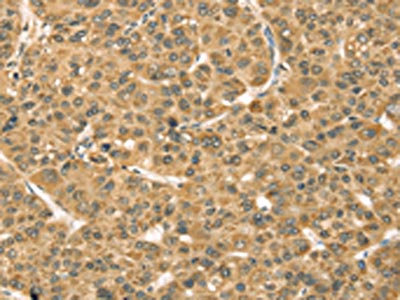 The image on the left is immunohistochemistry of paraffin-embedded Human liver cancer tissue using CSB-PA823439(TMPRSS3 Antibody) at dilution 1/35, on the right is treated with synthetic peptide. (Original magnification: ×200)
-
-
其他:
產品詳情
-
Uniprot No.:
-
基因名:TMPRSS3
-
別名:TMPRSS3; ECHOS1; TADG12; UNQ323/PRO382; Transmembrane protease serine 3; Serine protease TADG-12; Tumor-associated differentially-expressed gene 12 protein
-
宿主:Rabbit
-
反應種屬:Human,Mouse
-
免疫原:Synthetic peptide of Human TMPRSS3
-
免疫原種屬:Homo sapiens (Human)
-
標記方式:Non-conjugated
-
抗體亞型:IgG
-
純化方式:Antigen affinity purification
-
濃度:It differs from different batches. Please contact us to confirm it.
-
保存緩沖液:-20°C, pH7.4 PBS, 0.05% NaN3, 40% Glycerol
-
產品提供形式:Liquid
-
應用范圍:ELISA,IHC
-
推薦稀釋比:
Application Recommended Dilution ELISA 1:2000-1:5000 IHC 1:25-1:100 -
Protocols:
-
儲存條件:Upon receipt, store at -20°C or -80°C. Avoid repeated freeze.
-
貨期:Basically, we can dispatch the products out in 1-3 working days after receiving your orders. Delivery time maybe differs from different purchasing way or location, please kindly consult your local distributors for specific delivery time.
-
用途:For Research Use Only. Not for use in diagnostic or therapeutic procedures.
產品評價

相關產品
靶點詳情
-
功能:Probable serine protease that plays a role in hearing. Acts as a permissive factor for cochlear hair cell survival and activation at the onset of hearing and is required for saccular hair cell survival. Activates ENaC (in vitro).
-
基因功能參考文獻:
- TMPRSS3 contributed to gastric cancer progression via activation of the PI3K/Akt/ERK signaling pathway. PMID: 30142546
- Pathogenic variants in the TMPRSS3 gene in a cohort of 2247 subjects with sensorineural hearing loss represented 13 different rare TMPRSS3 variants, nine of which were novel. PMID: 28566687
- knockdown of TMPRSS3 inhibits proliferation, migration, and invasion in human nasopharyngeal carcinoma cells through the inactivation of the PI3K/Akt signaling pathway. This study suggests that TMPRSS3 may be a potential therapeutic target for the treatment of nasopharyngeal carcinoma PMID: 28409556
- For those with a combination of severely pathogenic TMPRSS3 variants, rapid aggravation of the residual hearing should be anticipated and treated accordingly. Our confirmation of the genotype-phenotype correlation of the TMPRSS3 gene may pave the way for the establishment of a personalized auditory rehabilitation. PMID: 29072634
- Our results indicate that mutations in TMPRSS3 account for about 4.6% (7/151) of Chinese autosomal recessive nonsyndromic hearing loss cases lacking mutations in SLC26A4 or GJB2 and that the recurrent TMPRSS3 mutation p.Ala306Thr is likely to be a founder mutation. PMID: 28695016
- Given that a previous paper suggested TMPRSS3 and GJB2 genes as responsible for a digenic form of hearing loss, our data support and reinforce this hypothesis. PMID: 28263784
- In conclusion, TMPRSS3 and TNFRSF11B may have potential prognostic value to be used as tumor biomarkers in breast cancer patients. PMID: 28260080
- different combinations of TMPRSS3 mutations led to different hearing impairment phenotypes (DFNB8/DFNB10) in the Chinese family. PMID: 28246597
- TMPRSS3 mutations seem to be an important cause of autosomal recessive nonsyndromic hearing loss in Slovenia resulting in rather uniform phenotype with profound congenital hearing loss. PMID: 26036852
- Study demonstrated that TMPRSS3 contributes to ovarian cancer cell proliferation, invasion and metastasis, probably via activation of the ERK1/2 signaling pathway. PMID: 26531004
- TMPRSS3 expression is an independent prognostic factor for breast cancer patients. Bioinformatic analysis of potential TMPRSS3 binding proteins revealed that TMPRSS3 could be a key regulator of cancer pathways. PMID: 26191247
- Low expression levels of hepsin and TMPRSS3 are associated with poor breast cancer survival PMID: 26014348
- Single nucleotide polymorphisms in TMPRSS3 (rs3814903 and rs11203200) are significantly associated with breast cancer risk. PMID: 25029565
- homozygous mutation TMPRSS3: c.535G>A causes prelingual hearing loss in this Tibetan family PMID: 25474651
- The prevalence of TMPRSS3 mutations among Korean postlingual hearing loss is 8.3 %. The p.A306T variant of TMPRSS3 is the common founder allele in Koreans. A novel variant, p.T248M of TMPRSS3, was predicted to have milder pathogenicity. PMID: 24526180
- Description of the spectrum of mutations in TMPRSS3 in 374 families with autosomal recessive, non-syndromic hearing loss from India. PMID: 24416283
- Association between TMPRSS3 genotypes and phenotype variants in autosomal recessive nonsyndromic hearing loss. PMID: 23958653
- Six TMPRSS3 variants were found to cosegregate in 10 consanguineous Pakistani families with autosomal recessive non-syndromic hearing impairment. PMID: 21534946
- Data imply that TMPRSS3-A/D overexpression in EOC is probably due to hypomethylation of their control region. PMID: 22446619
- TMPRSS3 gene is not a major contributor to non-syndromic deafness in the Moroccan population. PMID: 22382023
- Our data suggest that not only the protein truncating mutation p.T70fs has a severe effect but also the amino acid substitutions p.Ala306Thr and p.Val199Met. PMID: 21786053
- TMPRSS3 mutations contribute to fewer than 1% of nonsyndromic childhood deafness in Caucasians. PMID: 11907649
- The TMPRSS3 protein mutated in deafness DFNB8/10 activates the epithelial sodium channel (ENaC) in vitro PMID: 12393794
- Disruption of the proteolytic activity of TMPRSS3 is tightly correlated with the pathogenesis of hearing loss. PMID: 12920079
- Identification of mutations in TMPRSS3 in Pakistani families with recessive, nonsyndromic congenital deafness. PMID: 15447792
- The mutant TMPRSS3 harboring the novel R216L missense mutation within the predicted cleavage site of the protein fails to undergo proteolytic cleavage and is unable to activate ENaC. PMID: 16021470
- The identification of two novel pathogenic TMPRSS3 mutations (c.646C-->T - R216C; c.916G-->A - A306T) is described in four affected siblings of German origin with postlingual hearing loss, treated by bilateral cochlear implantation with good results. PMID: 17551081
- TMPRSS3 mutations are not a common cause of hereditary deafness, but the elucidation of its function is nevertheless important for better understanding of hearing [review] PMID: 17981648
- missense mutations in autosomal recessive sensorineural deafness PMID: 11462234
顯示更多
收起更多
-
相關疾病:Deafness, autosomal recessive, 8 (DFNB8)
-
亞細胞定位:Endoplasmic reticulum membrane; Single-pass type II membrane protein.
-
蛋白家族:Peptidase S1 family
-
組織特異性:Expressed in many tissues including fetal cochlea. Isoform T is found at increased levels in some carcinomas.
-
數據庫鏈接:
Most popular with customers
-
-
YWHAB Recombinant Monoclonal Antibody
Applications: ELISA, WB, IHC, IF, FC
Species Reactivity: Human, Mouse, Rat
-
Phospho-YAP1 (S127) Recombinant Monoclonal Antibody
Applications: ELISA, WB, IHC
Species Reactivity: Human
-
-
-
-
-