CNGA3 Antibody
-
中文名稱(chēng):CNGA3兔多克隆抗體
-
貨號(hào):CSB-PA292433
-
規(guī)格:¥1100
-
圖片:
-
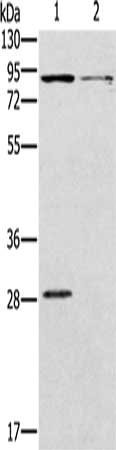 Gel: 8%SDS-PAGE, Lysate: 40 μg, Lane 1-2: Mouse kidney tissue, Mouse brain tissue, Primary antibody: CSB-PA292433(CNGA3 Antibody) at dilution 1/500, Secondary antibody: Goat anti rabbit IgG at 1/8000 dilution, Exposure time: 2 minutes
-
-
其他:
產(chǎn)品詳情
-
Uniprot No.:
-
基因名:
-
別名:CNGA3; CNCG3; Cyclic nucleotide-gated cation channel alpha-3; Cone photoreceptor cGMP-gated channel subunit alpha; Cyclic nucleotide-gated channel alpha-3; CNG channel alpha-3; CNG-3; CNG3
-
宿主:Rabbit
-
反應(yīng)種屬:Human,Mouse
-
免疫原:Fusion protein of Human CNGA3
-
免疫原種屬:Homo sapiens (Human)
-
標(biāo)記方式:Non-conjugated
-
抗體亞型:IgG
-
純化方式:Antigen affinity purification
-
濃度:It differs from different batches. Please contact us to confirm it.
-
保存緩沖液:-20°C, pH7.4 PBS, 0.05% NaN3, 40% Glycerol
-
產(chǎn)品提供形式:Liquid
-
應(yīng)用范圍:ELISA,WB
-
推薦稀釋比:
Application Recommended Dilution ELISA 1:1000-1:2000 WB 1:200-1:1000 -
Protocols:
-
儲(chǔ)存條件:Upon receipt, store at -20°C or -80°C. Avoid repeated freeze.
-
貨期:Basically, we can dispatch the products out in 1-3 working days after receiving your orders. Delivery time maybe differs from different purchasing way or location, please kindly consult your local distributors for specific delivery time.
-
用途:For Research Use Only. Not for use in diagnostic or therapeutic procedures.
產(chǎn)品評(píng)價(jià)

相關(guān)產(chǎn)品
靶點(diǎn)詳情
-
功能:Visual signal transduction is mediated by a G-protein coupled cascade using cGMP as second messenger. This protein can be activated by cyclic GMP which leads to an opening of the cation channel and thereby causing a depolarization of cone photoreceptors. Induced a flickering channel gating, weakened the outward rectification in the presence of extracellular calcium, increased sensitivity for L-cis diltiazem and enhanced the cAMP efficacy of the channel when coexpressed with CNGB3. Essential for the generation of light-evoked electrical responses in the red-, green- and blue sensitive cones.
-
基因功能參考文獻(xiàn):
- Here, we report the identification of a novel isoform of human CNGA3 resulting from an in-frame alternative translation initiation site (TIS) 154 bp downstream of the first TIS. Results suggest that the short isoform is not able to compensate for the loss of the long isoform leaving the biological role of this variant unclear. PMID: 29499183
- The c.1618G>A, p.Gly540Ser substitution in CNGA3 was identified as the causative mutation for a novel form of ACHM in Awassi sheep. Gene augmentation therapy restored vision in the affected sheep. This novel mutation provides a large-animal model that is valid for most human CNGA3 ACHM patients; the majority of them carry missense rather than premature-termination mutations. PMID: 28282490
- Four mutations (c.1682G>A;p.G561E, c.139C>T;p.Q47*, c.784G>C;p.A282P, c.1116delC;p.V373*) represent novel mutations of CNGA3 reported herein for the first time in patients with Achromatopsia. PMID: 28159970
- The two novel mutations found in the CNGA3 gene, c.997_998delGA and p.M424V, can cause complete achromatopsia. The vision of the patient was stationary until the third decade of life although the FAF was altered at the age of 22 years. PMID: 27040408
- The c.955T>C change identified in large consanguineous Pakistani family represents the first variant of CNGA3 which was found to be responsible for the cone-rod dystrophy phenotype. PMID: 25052312
- Among Israeli and Palestinian patients, CNGA3 mutations are the leading cause of achromatopsia. Retinal structural results support the candidacy of CNGA3 ACHM for clinical trials for therapy of cone photoreceptors. PMID: 25616768
- CNGA3 mutation is the most frequent cause of achromatopsia in this cohort of patients. Ten novel mutations were identified in CNGA3. PMID: 25637600
- Our results suggest that CNGA3 mutations are a common cause of cone-rod dystrophies and achromatopsia in the Chinese population. PMID: 24903488
- Genetic testing revealed a common homozygous mutation in CNGB3 in 5 patients with complete achromatopsia and heterozygous mutations in CNGA3 in 2 patients with incomplete achromatopsia. PMID: 24676353
- CNGA3 alternative splicing may have evolved, in part, to tune the interactions between cone CNG channels and membrane-bound phosphoinositides. PMID: 24675082
- The majority (n = 12) of patients were either homozygotes or compound heterozygotes for known achromatopsia alleles, two in CNGB3 (p.T383fsX and p.T296YfsX9) and three in CNGA3 (p.R283Q, p.R427C and p.L527R). PMID: 23362848
- The biochemical feedback regulation of CNGA3 mutations in color blindness is reported. PMID: 23677796
- These studies support a model in which intersubunit interactions control the sensitivity of cone CNG channels to regulation by phosphoinositides. PMID: 23552282
- in a set of consanguineous patient families with Leber congenital amaurosis study identified five putative disease-causing mutations, including four novel alleles, in six families; These five mutations are located in four genes, ALMS1, IQCB1, CNGA3, and MYO7A PMID: 21901789
- observed a nuclear translocation of apoptosis-inducing factor (AIF) and endonuclease G in CNGA3(-/-)/Nrl(-/-) and CNGB3(-/-)/Nrl(-/-) retinas, implying a mitochondrial insult in the endoplasmic reticulum stress-activated cell death process PMID: 22493484
- We describe a novel S4 motif mutation of CNGA3 in a Pakistani family. PMID: 21912902
- Two compound heterozygous mutations were identified in CNGA3 of this patient, c.829C>T p.R277C and c.1580T>G p.L527R; they were not observed in the normal population and cosegregated with the phenotype of achromatopsia in the patient's family. PMID: 21911670
- Missense mutations, nonsense mutations, splice mutations, and small deletions and insertions in the affected genes cause achromatopsia. PMID: 21267001
- This is the second reported case of CNGA3 associated oligocone trichromacy (OT). PMID: 21268679
- Data identified three novel mutations in the pore-forming region of CNGA3 (L363P, G367V, and E376K) in achromatopsia patients, and reduced macroscopic currents for channels with the mutations G367V, and E376K. PMID: 20506298
- haplotype analysis of c.1585G>A-bearing chromosomes from Middle Eastern and European origins showed a shared Muslim-Jewish haplotype, different from that detected in Europeans, indicating a recurrent mutation with a Jewish-Muslim founder effect PMID: 20549516
- Genetic analysis of two Pakistani families with retinal disease enabled the establishment of the correct diagnosis of achromatopsia. Two novel mutations were identified in CNGA3 and CNGB3 that are both specifically expressed in cone photoreceptors. PMID: 20454696
- Our data indicate that these genes are involved in a broader spectrum of cone dysfunction, and it remains intriguing why initial cone function can be spared despite similar gene defects. PMID: 20079539
- Novel causative CNGA3 missense mutations found in Achromatopsia patients in the United Kingdom. PMID: 14757870
- the S4 structural motif of CNGA3 is important for cellular processing of cone photoreceptor cyclic GMP-gated ion channels PMID: 15024024
- Functional markers for CNGA3 (A3) dimers confirms that A3 subunits gain membership into the pore-forming tetramers and that like subunits are positioned adjacent to each other in cone photoreceptors. PMID: 15134637
- Out of 36 achromats, 12 (33%) had mutations in CNGA3 (13 different mutations including five novel mutations). PMID: 15712225
- Plasma membrane localization and gating properties of cone CNGA3 channels are altered by progressive cone dystrophy-associated mutations, evidence of pathogenicity of these mutations. PMID: 15743887
- Mutations in CNGA3 and CNGB3 account for achromatopsia in Hungarian patients including known mutations and a few new CNGB3 mutations. PMID: 16319819
- The outcome suggests low frequency (7%, 1/14) of CNGA3 mutations (R436W, L633P) in Japanese patients. PMID: 16961972
- Phospholipid metabolism and exogenously applied phosphatidylinositol 3,4,5-trisphosphate can modulate heterologously expressed cone CNG channels. PMID: 17018579
- the T565M and E593K mutations of CNGA3 alter the apparent affinity for cGMP of the channels to cause cone dysfunction, resulting in rod monochromacy PMID: 17693388
- identification of three new CNGA3 mutations in patients with achromatopsia PMID: 18445228
- The identification of three novel CNGA3 missense mutations in achromatopsia patients. PMID: 18521937
- Achromatopsia in these two United Arab Emirates families results from two different mutations in CNGA3. PMID: 18636117
- The CNGB3 gene was by far the most important causal gene, and T383IfsX13 the most frequent mutation in complete and incomplete achromatopsia. PMID: 19592100
- mutations in cone photoreceptor disorders PMID: 11536077
顯示更多
收起更多
-
相關(guān)疾病:Achromatopsia 2 (ACHM2)
-
亞細(xì)胞定位:Membrane; Multi-pass membrane protein.
-
蛋白家族:Cyclic nucleotide-gated cation channel (TC 1.A.1.5) family, CNGA3 subfamily
-
組織特異性:Prominently expressed in retina.
-
數(shù)據(jù)庫(kù)鏈接:
Most popular with customers
-
-
YWHAB Recombinant Monoclonal Antibody
Applications: ELISA, WB, IHC, IF, FC
Species Reactivity: Human, Mouse, Rat
-
Phospho-YAP1 (S127) Recombinant Monoclonal Antibody
Applications: ELISA, WB, IHC
Species Reactivity: Human
-
-
-
-
-