Recombinant Mouse T-cell immunoglobulin and mucin domain-containing protein 4 (Timd4), partial
-
中文名稱:小鼠Timd4重組蛋白
-
貨號:CSB-YP747606MO
-
規格:
-
來源:Yeast
-
其他:
-
中文名稱:小鼠Timd4重組蛋白
-
貨號:CSB-EP747606MO
-
規格:
-
來源:E.coli
-
其他:
-
中文名稱:小鼠Timd4重組蛋白
-
貨號:CSB-EP747606MO-B
-
規格:
-
來源:E.coli
-
共軛:Avi-tag Biotinylated
E. coli biotin ligase (BirA) is highly specific in covalently attaching biotin to the 15 amino acid AviTag peptide. This recombinant protein was biotinylated in vivo by AviTag-BirA technology, which method is BriA catalyzes amide linkage between the biotin and the specific lysine of the AviTag.
-
其他:
-
中文名稱:小鼠Timd4重組蛋白
-
貨號:CSB-BP747606MO
-
規格:
-
來源:Baculovirus
-
其他:
-
中文名稱:小鼠Timd4重組蛋白
-
貨號:CSB-MP747606MO
-
規格:
-
來源:Mammalian cell
-
其他:
產品詳情
-
純度:>85% (SDS-PAGE)
-
基因名:Timd4
-
Uniprot No.:
-
別名:Timd4; Tim4; T-cell immunoglobulin and mucin domain-containing protein 4; TIMD-4; Spleen; mucin-containing; knockout of lymphotoxin protein; SMUCKLER; T-cell immunoglobulin mucin receptor 4; TIM-4; T-cell membrane protein 4
-
種屬:Mus musculus (Mouse)
-
蛋白長度:Partial
-
蛋白標簽:Tag?type?will?be?determined?during?the?manufacturing?process.
The tag type will be determined during production process. If you have specified tag type, please tell us and we will develop the specified tag preferentially. -
產品提供形式:Lyophilized powder
Note: We will preferentially ship the format that we have in stock, however, if you have any special requirement for the format, please remark your requirement when placing the order, we will prepare according to your demand. -
復溶:We recommend that this vial be briefly centrifuged prior to opening to bring the contents to the bottom. Please reconstitute protein in deionized sterile water to a concentration of 0.1-1.0 mg/mL.We recommend to add 5-50% of glycerol (final concentration) and aliquot for long-term storage at -20℃/-80℃. Our default final concentration of glycerol is 50%. Customers could use it as reference.
-
儲存條件:Store at -20°C/-80°C upon receipt, aliquoting is necessary for mutiple use. Avoid repeated freeze-thaw cycles.
-
保質期:The shelf life is related to many factors, storage state, buffer ingredients, storage temperature and the stability of the protein itself.
Generally, the shelf life of liquid form is 6 months at -20°C/-80°C. The shelf life of lyophilized form is 12 months at -20°C/-80°C. -
貨期:Delivery time may differ from different purchasing way or location, please kindly consult your local distributors for specific delivery time.Note: All of our proteins are default shipped with normal blue ice packs, if you request to ship with dry ice, please communicate with us in advance and extra fees will be charged.
-
注意事項:Repeated freezing and thawing is not recommended. Store working aliquots at 4°C for up to one week.
-
Datasheet :Please contact us to get it.
產品評價

靶點詳情
-
功能:Phosphatidylserine receptor that enhances the engulfment of apoptotic cells. Involved in regulating T-cell proliferation and lymphotoxin signaling. Ligand for HAVCR1/TIMD1.
-
基因功能參考文獻:
- These results indicate that TAM and Tim4 collaborate for efficient efferocytosis in certain macrophage populations. PMID: 28768810
- TIM-4 is expressed on iNKT cells but dispensable for their development and function. PMID: 27662666
- TIM-4 was differentially expressed in the distinct subsets of DCs in skin and skin-draining LNs, and specifically regulated epidermal LC and LN CD207-CD4+ DC homeostasis PMID: 27224924
- identified TIM-4 as a novel marker for B effector 1 (Be1) cells that depend on IFN-gamma for their proinflammatory activity; TIM-4(+) B cells are enriched for IFN-gamma-producing proinflammatory Be1 cells that enhance immune responsiveness and can be specifically targeted with anti-TIM-4. PMID: 28848066
- Oral treatment with the mucosal adjuvant cholera toxin (CT) induces expression of T cell immunoglobulin and mucin domain containing 4 (TIM-4) on a proportion of CD103+ CD11b+ dendritic cell (DC) in the intestinal lamina propria (LP). PMID: 27379516
- attenuated LPS-induced endotoxic shock by inhibiting cytokine production by macrophages PMID: 27617399
- analysis of the molecular characteristics of both mTIM-4 and hTIM-4 provides a better understanding of the regions of the TIM-4 IgV domain critical for Ebola virus entry PMID: 27122575
- STAT6 mediates the CT-induced TIM4 expression in DCs. In conclusion, p300 and STAT6 mediate the microbial product CT-induced TIM4 expression in DCs. PMID: 26899911
- Blockade of Tim-4 aggravates atherosclerosis in LDL receptor knockout mice likely by prevention of phagocytosis of phosphatidylserine-expressing apoptotic cells and activated T cells by Tim-4-expressing cells. PMID: 26821944
- results indicate that Tim-4 is involved in negative regulation of NO production in macrophages, suggesting the critical role of Tim-4 in immune related diseases PMID: 25905790
- TIM-4 on dendritic cells plays a critical role in hepatic ischemia-reperfusion (IR) injury and may be an efficient target for the prevention of liver or other organ IR injuries. PMID: 25771178
- M2-like TIM-4hiCD169+ tissue-resident macrophages are immunoregulatory and promote engraftment of cardiac allografts, but their influence is diminished by TIM-4-dependent programmed cell death PMID: 24983317
- intrinsic macrophage-specific TIM-4 signaling has indispensable role in innate immunity-driven liver ischemia-reperfusion injury PMID: 25066922
- TIM4 engages integrins as coreceptors to evoke the signal transduction needed to internalize PtdSer-bearing targets such as apoptotic cells. PMID: 24623723
- Tim-4 expression was higher in Behcet's disease (BD) mice than that in BDN mice. PMID: 24453431
- In addition to the known phosphatidylserine(PS) binding pocket, Tim4 has four weaker sites of interaction, making it sensitive to PS surface concentration in a manner capable of differential recognition on the basis of PS exposure level. PMID: 24706780
- the engulfment of apoptotic cells by resident peritoneal macrophages proceeds in two steps: binding to Tim4, a PtdSer receptor, followed by MerTK-mediated cell engulfment PMID: 24515440
- Data suggest that trans-membrane (or T cell) immunoglobulin and mucin (TIM) molecules are expressed in embryonic hematopoietic tissues in chicken and mouse and that in fetal liver, TIM-4 is expressed by myeloid progenitor cells. PMID: 24316337
- TIM-4 directly interacted with AMPKalpha1 and activated autophagy-mediated degradation of ingested tumors, leading to reduced antigen presentation and impaired CTL responses PMID: 24315994
- The therapeutic effect of anti-TIM-4 mAb on arthritis is mediated by the inhibition of proinflammatory cytokine production by inflammatory cells, osteoclast differentiation, and bone resorption. PMID: 24068667
- In RAG(-/-) recipients of skin allografts adoptively transferred with CD4( ) T cells, findings show that TIM-4 blockade in vivo is associated with a 3-fold prolongation in allograft survival. PMID: 24038092
- TIM-4-mediated clearance of antigen specific T cells represents an important previously unrecognized mechanism regulating respiratory tolerance. PMID: 23149665
- aged female mice deficient in both MFG-E8 and Tim4 developed autoantibodies in an age-dependent manner PMID: 22723547
- Wild type TIM-4, a receptor for phosphatidylserine (a marker of apoptotic cells) regulates adaptive immunity in part by mediating the removal of antigen-specific T cells during the contraction phase of the response. PMID: 21037090
- These data support an indispensible role of Tim-4 in maintaining the homeostasis of resident peritoneal macrophages. PMID: 20421466
- TIM-4 is critical for the clearance of apoptotic bodies in vivo, and that lack of TIM-4 results in aberrant persistence of apoptotic bodies leading to dysregulated lymphocyte activation and signs of systemic autoimmunity. PMID: 20368430
- TIM-1-TIM-4 interaction is involved in regulating T cell proliferation. PMID: 15793576
- results indicate that Tim4 and Tim1 are phosphatidylserine receptors for the engulfment of apoptotic cells, and may also be involved in intercellular signalling in which exosomes are involved PMID: 17960135
- Tim-4, expressed on APCs, is a costimulatory molecule that promotes T cell expansion and survival by cross-linking Tim-1 on T cells PMID: 18354194
- results suggest that TIM-4 exerts bimodal functions depending on the activation status of T cells PMID: 18367551
- concurrent exposure to cholera toxin (CT) & peanut extract (PE) increases TIM4 expression in dendritic cells(DC)& promotes DC maturation, which plays an important role in initiation of PE-specific T(H)2 polarization &allergy in the intestine PMID: 18547633
顯示更多
收起更多
-
亞細胞定位:Membrane; Single-pass type I membrane protein.
-
蛋白家族:Immunoglobulin superfamily, TIM family
-
組織特異性:Predominantly expressed in lymphoid tissues, such as spleen, lymph nodes, and Peyer patches. Also expressed in fetal liver, salivary gland, and spleen stromal cells, predominantly in the marginal zone and to a lesser extent throughout the white pulp. Not
-
數據庫鏈接:
Most popular with customers
-
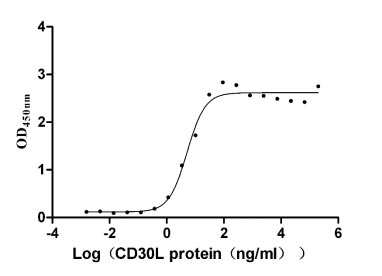
Recombinant Human Tumor necrosis factor ligand superfamily member 8 (TNFSF8), partial (Active)
Express system: Mammalian cell
Species: Homo sapiens (Human)
-
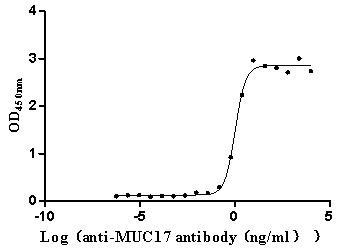
Recombinant Human Mucin-17 (MUC17), partial (Active)
Express system: Mammalian cell
Species: Homo sapiens (Human)
-
-AC1.jpg)
Recombinant Human Dickkopf-related protein 1 (DKK1) (Active)
Express system: Mammalian cell
Species: Homo sapiens (Human)
-
-
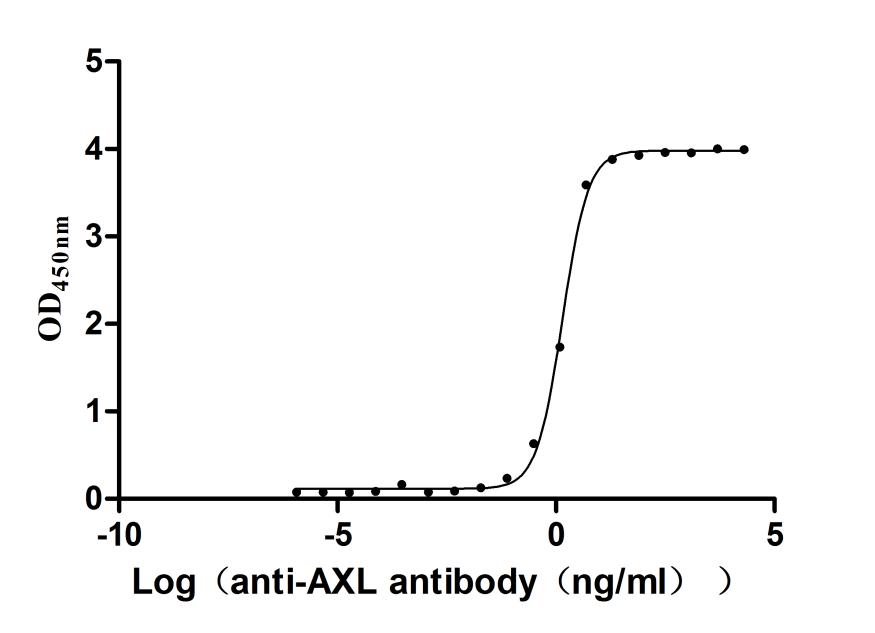
Recombinant Human Tyrosine-protein kinase receptor UFO(AXL),partial (Active)
Express system: Mammalian cell
Species: Homo sapiens (Human)