TXNIP Antibody
-
中文名稱:TXNIP兔多克隆抗體
-
貨號:CSB-PA880966LA01HU
-
規格:¥440
-
圖片:
-
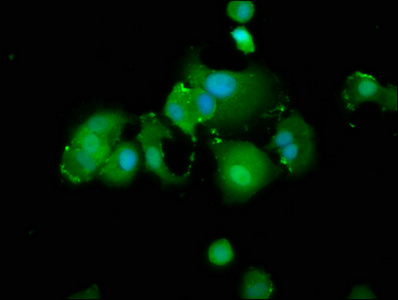 Immunofluorescence staining of MCF-7 cells with CSB-PA880966LA01HU at 1:166, counter-stained with DAPI. The cells were fixed in 4% formaldehyde, permeabilized using 0.2% Triton X-100 and blocked in 10% normal Goat Serum. The cells were then incubated with the antibody overnight at 4°C. The secondary antibody was Alexa Fluor 488-congugated AffiniPure Goat Anti-Rabbit IgG(H+L).
-
-
其他:
產品詳情
-
產品名稱:Rabbit anti-Homo sapiens (Human) TXNIP Polyclonal antibody
-
Uniprot No.:
-
基因名:
-
別名:TXNIP; VDUP1; Thioredoxin-interacting protein; Thioredoxin-binding protein 2; Vitamin D3 up-regulated protein 1
-
宿主:Rabbit
-
反應種屬:Human
-
免疫原:Recombinant Human Thioredoxin-interacting protein (299-381AA)
-
免疫原種屬:Homo sapiens (Human)
-
標記方式:Non-conjugated
本頁面中的產品,TXNIP Antibody (CSB-PA880966LA01HU),的標記方式是Non-conjugated。對于TXNIP Antibody,我們還提供其他標記。見下表:
-
克隆類型:Polyclonal
-
抗體亞型:IgG
-
純化方式:>95%, Protein G purified
-
濃度:It differs from different batches. Please contact us to confirm it.
-
保存緩沖液:Preservative: 0.03% Proclin 300
Constituents: 50% Glycerol, 0.01M PBS, pH 7.4 -
產品提供形式:Liquid
-
應用范圍:ELISA, IF
-
推薦稀釋比:
Application Recommended Dilution IF 1:50-1:200 -
Protocols:
-
儲存條件:Upon receipt, store at -20°C or -80°C. Avoid repeated freeze.
-
貨期:Basically, we can dispatch the products out in 1-3 working days after receiving your orders. Delivery time maybe differs from different purchasing way or location, please kindly consult your local distributors for specific delivery time.
-
用途:For Research Use Only. Not for use in diagnostic or therapeutic procedures.
產品評價

相關產品
靶點詳情
-
功能:May act as an oxidative stress mediator by inhibiting thioredoxin activity or by limiting its bioavailability. Interacts with COPS5 and restores COPS5-induced suppression of CDKN1B stability, blocking the COPS5-mediated translocation of CDKN1B from the nucleus to the cytoplasm. Functions as a transcriptional repressor, possibly by acting as a bridge molecule between transcription factors and corepressor complexes, and over-expression will induce G0/G1 cell cycle arrest. Required for the maturation of natural killer cells. Acts as a suppressor of tumor cell growth. Inhibits the proteasomal degradation of DDIT4, and thereby contributes to the inhibition of the mammalian target of rapamycin complex 1 (mTORC1).
-
基因功能參考文獻:
- Using oxygen-glucose deprivation and reoxygenation (OGD/R) to create a cell model of hepatic I/R injury, we found that the mRNA and protein expression levels of TXNIP were upregulated in HL7702cells exposed to OGD/R. PMID: 29852169
- Expression of TXNIP2 isoform, not TXNIP1, is upregulated in leukocytes of patients with acute myocardial infarction. PMID: 30034557
- Thioredoxin-interacting protein (TXNIP) is highly induced in retinal vascular endothelial cells under diabetic conditions. Data (including data from studies using knockout mice) suggest that TXNIP in retinal vascular endothelial cells plays role in diabetic retinal angiogenesis via VEGF/VEGFR2 and Akt/mTOR signaling. (VEGFR2 = vascular endothelial growth factor receptor-2) PMID: 29203232
- miR-20a could negatively regulate TLR4 and NLRP3 signaling to protect human aortic endothelial cells from inflammatory injuries. PMID: 29653364
- Results found the mRNA level of TRX-1 was significantly decreased (p<0.005), while the mRNA levels of TBP-2, COX-2, and TNF-alpha were significantly increased in the placentas in preeclampsia when compared to the normal group. PMID: 29999276
- Consistent with its enhanced expression in Laron syndrome, we provide evidence that TXNIP gene expression is negatively regulated by IGF1. PMID: 29339473
- TXNIP contributes to the dysregulation of tubular autophagy and mitophagy in diabetic nephropathy through activation of the mTOR signaling pathway. PMID: 27381856
- This study thus characterizes ERK-mediated suppression of TXNIP as a presently unreported mechanism by which ap junctions regulate cell behaviors. PMID: 28694028
- Results indicate an internal ribosome entry sites (IRESes) within the thioredoxin-interacting protein (TXNIP) protein; 5' untranslated region (5'UTR), and regulatory IRES trans-acting factors. PMID: 29378331
- The data of this study suggested that TXNIP blocked autophagic flux and induced alpha-synuclein accumulation through inhibition of ATP13A2. PMID: 28755477
- Compared with normal tissues, TXNIP expression was significantly decreased in human breast cancer tissues and canine mammary tumors, along with tumor progression. PMID: 29524408
- This finding suggested statistically significant role of interaction of TXNIP and AF1q polymorphisms (TXNIP-rs2236566, TXNIP-rs7211, and AF1q-rs2769605) in schizophrenia susceptibility. PMID: 27510506
- summarize the current state of our understanding of TXNIP biology, highlight its role in metabolic regulation and raise critical questions that could help future research to exploit TXNIP as a therapeutic target PMID: 28137209
- intracellular TXNIP protein is a critical regulator of activation of the fructose-induced NLRP3 inflammasome PMID: 28326454
- This study provides insight into the molecular mechanisms of TXNIP overexpression in liver cancer cell survival and apoptosis and indicated that TXNIP may be a novel promising agent for liver cancer treatment. PMID: 28440491
- Study showed that the expression of TXNIP was significantly increased in RNF2 knockdown prostate tumor cells and that TXNIP is an important downstream target of RNF2. PMID: 28029659
- Depletion of glycolytic intermediates led to a consistent decrease in TXNIP expression in response to 1,25(OH)2D3, an effect that coincided with the activation of AMPK signaling and a reduction in c-MYC expression. PMID: 28651973
- We found no evidence of decreased TXNIP DNA methylation or increased gene expression in metabolic target tissues of offspring exposed to maternal diabetes. Further studies are needed to confirm and understand the paradoxical SAT TXNIP DNA methylation and gene expression changes in O-GDM subjects PMID: 29077742
- the association of TXNIP (thioredoxin-interacting protein) with NLRP3 induced by ROS promoted NLRP3 inflammasome activation in senescent HUVEC endothelial cells PMID: 28064010
- histone acetylation serves as a key regulator of glucose-induced increase in TXNIP gene expression PMID: 27989964
- thioredoxin-interacting protein deficiency alleviates diabetic renal lipid accumulation through regulation of Akt/mTOR pathway PMID: 27497988
- High expression of TXNIP indicates a lower pathological grade of meningnioma, and is also associated with longer recurrence-free time. PMID: 28243945
- All-trans retinoic acid plays a key role in inhibition of hepatic stellate cell activation via suppressing TXNIP expression, which reduces oxidative stress levels. PMID: 28322443
- Study shows that TXNIP expression is down-regulated in new Multiple Sclerosis (MS) patients compared to controls and might be implicated in pathogenesis of the disease. PMID: 28844667
- TXNIP Single nucleotide polymorphisms may individually and cumulatively affect CAD risk through a possible mechanism for regulating TXNIP expression and gene-environment interactions. PMID: 27470124
- Taken together, our results firstly reveal that TMAO induces inflammation and endothelial dysfunction via activating ROS-TXNIP-NLRP3 inflammasome, suggest a likely mechanism for TMAO-dependent enhancement in atherosclerosis and cardiovascular risks. PMID: 27833015
- results suggest that TXNIP is required early in the apoptotic-inducing pathway resulting from r-Moj-DM binding to the alphav integrin subunit PMID: 27567705
- Hypoxia suppresses thioredoxin binding protein-2 gene expression, which may ultimately alter placental development. PMID: 27762463
- Heme oxygenase rs2071749 polymorphism was positively associated with obesity in Mexicans. PMID: 27274779
- These data identify novel Txnip protein interactions. PMID: 27437069
- Glucose exerts strong stimulatory effects on activation histone marks while having inhibitory effects on repression marks in the promoter of the TXNIP gene, and this was associated with a marked increase in expression of the proinflammatory gene in kidney. PMID: 26806835
- No evidence that SNPS in TXNIP has effect, but the rs4485648 polymorphism of the TrxR2 gene might exert an independent effect on the development of Diabetic retinopathy. PMID: 26763822
- An association has been found between the TXNIP gene methylation pattern and type 2 diabetes mellitus in ischemic stroke patients through epigenetic mechanisms, related to sustained hyperglycemia levels with HbA1c >/= 7%. PMID: 26643952
- These findings thereby provide new mechanistic insight into the regulation of TXNIP and beta-cell biology and reveal novel links between proinflammatory cytokines, carbohydrate response element binding protein-mediated transcription, and microRNA signaling. PMID: 26858253
- The crystal structure of the complex between a phosphorylated PPxY motif of TXNIP and the SH2 domain of Vav2 reveals a conserved recognition mechanism. PMID: 26919541
- Activation of the miR-373-TXNIP-HIF1alpha-TWIST signaling axis is correlated with a worse outcome in patients with breast cancer. PMID: 26196741
- Metformin down-regulates high-glucose-induced TXNIP transcription by inactivating ChREBP and FOXO1 in endothelial cells, partially through AMP-activated protein kinase activation PMID: 26147751
- Foam cell-released 4-hydroxnonenal activates PPARdelta in Vascular endothelial cells, leading to increased TXNIP expression and consequently to senescence. PMID: 25754218
- our data support the hypothesis that TXNIP is an effective target for the treatment of breast cancer. PMID: 25812606
- Expression of TXNIP was up-regulated in all three NSCLC cell lines. PMID: 25854388
- Data identify the metastasis suppressor TXNIP as new target of miR-224/miR-452 that induces feedback inhibition of E2F1 and show that miR-224/452-mediated downregulation of TXNIP is essential for E2F1-induced EMT and invasion PMID: 25341426
- HG-induced NADPH oxidase activation is driven by TXNIP which subsequently triggers NALP3 inflammasome activation in podocytes and ultimately led to podocyte injury PMID: 25834832
- Suggest that TXNIP plays a critical role in anti-Her-1/Her-2 treatment and may be a potential prognostic marker in breast cancer. PMID: 25605021
- The expression of TXNIP was significantly higher in normal-weight type- 2 diabetic patients than in obese ones. PMID: 25726203
- The inhibition of TRX by TXNIP is mediated by an intermolecular disulphide interaction resulting from a novel disulphide bond-switching mechanism. This bond dissociates in the presence of high concentrations of reactive oxygen species. PMID: 24389582
- The protein expression level of TXNIP was negatively correlated with the level of miR-373 in MCF-7 cells and in breast cancer tissue of various migration and invasion abilities. TXNIP was regulated by miR-373. PMID: 26122224
- data suggest that loss of the p53 tumor suppressor cooperates with Mychigh/TXNIPlow-driven metabolic dysregulation to drive the aggressive clinical behavior of TNBC. PMID: 25870263
- diabetes was associated with a >30-fold increase in TxnIP gene expression and a 17 % increase in TxnIP protein expression. PMID: 24925443
- TXNIP has been discovered to control pancreatic B-cell microRNA expression, B-cell function, and insulin production. [Review] PMID: 24911120
- regulatory relationship between mTOR and the MondoA-TXNIP axis that we propose contributes to glucose homeostasis PMID: 25332233
顯示更多
收起更多
-
亞細胞定位:Cytoplasm.
-
蛋白家族:Arrestin family
-
數據庫鏈接:
Most popular with customers
-
-
YWHAB Recombinant Monoclonal Antibody
Applications: ELISA, WB, IHC, IF, FC
Species Reactivity: Human, Mouse, Rat
-
Phospho-YAP1 (S127) Recombinant Monoclonal Antibody
Applications: ELISA, WB, IHC
Species Reactivity: Human
-
-
-
-
-