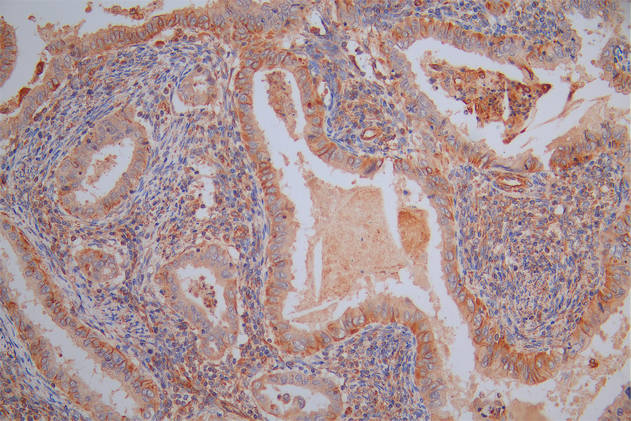
TULP1 Antibody
-
中文名稱:TULP1兔多克隆抗體
-
貨號:CSB-PA025346GA01HU
-
規格:¥3,900
-
其他:
產品詳情
-
Uniprot No.:
-
基因名:TULP1
-
別名:RP14 antibody; Tubby like protein 1 antibody; Tubby related protein 1 (Tubby like protein 1) antibody; Tubby related protein 1 antibody; Tubby-like protein 1 antibody; Tubby-related protein 1 antibody; TUBL1 antibody; TULP 1 antibody; Tulp1 antibody; TULP1_HUMAN antibody
-
宿主:Rabbit
-
反應種屬:Human,Mouse,Rat
-
免疫原:Human TULP1
-
免疫原種屬:Homo sapiens (Human)
-
抗體亞型:IgG
-
純化方式:Antigen Affinity purified
-
濃度:It differs from different batches. Please contact us to confirm it.
-
保存緩沖液:PBS with 0.02% Sodium Azide, 50% Glycerol, pH 7.3. -20°C, Avoid freeze / thaw cycles.
-
產品提供形式:Liquid
-
應用范圍:ELISA,WB,IHC,IF
-
Protocols:
-
儲存條件:Upon receipt, store at -20°C or -80°C. Avoid repeated freeze.
-
貨期:Basically, we can dispatch the products out in 1-3 working days after receiving your orders. Delivery time maybe differs from different purchasing way or location, please kindly consult your local distributors for specific delivery time.
-
用途:For Research Use Only. Not for use in diagnostic or therapeutic procedures.
產品評價

相關產品
靶點詳情
-
功能:Required for normal development of photoreceptor synapses. Required for normal photoreceptor function and for long-term survival of photoreceptor cells. Interacts with cytoskeleton proteins and may play a role in protein transport in photoreceptor cells. Binds lipids, especially phosphatidylinositol 3-phosphate, phosphatidylinositol 4-phosphate, phosphatidylinositol 5-phosphate, phosphatidylinositol 3,4-bisphosphate, phosphatidylinositol 4,5-bisphosphate, phosphatidylinositol 3,4,5-bisphosphate, phosphatidylserine and phosphatidic acid (in vitro). Contribute to stimulation of phagocytosis of apoptotic retinal pigment epithelium (RPE) cells and macrophages.
-
基因功能參考文獻:
- Pathogenic mutations in TULP1 are responsible for the retinitis pigmentosa phenotype in seven familial cases with a common ancestral mutation responsible for the disease phenotype in four of the seven families. PMID: 27440997
- photoreceptor degeneration caused by missense mutations via endoplasmic reticulum unfolded protein response PMID: 26987071
- This study highlights the value of the broad sequencing strategy of exome sequencing for disease gene identification in Leber congenital amaurosis, over other existing methods. PMID: 24547928
- Data suggest that mutant tubby like protein 1 (TULP1) proteins are misfolded and accumulate within the endoplasmic reticulum (ER) leading to induction of the unfolded protein response (UPR) stress response complex. PMID: 26427415
- The TULP1 allele p.Gln301* represents a founder mutation on the Arabian Peninsula and is associated with a recognisable congenital recessive rod-cone dystrophy phenotype in the homozygous state. PMID: 25342276
- Retinal degeneration with TULP1 mutations leads to a small central island of residual foveal cones at early ages which are less sensitive than expected from the residual structure. PMID: 25074776
- Maternal uniparental isodisomy of chromosome 6 unmasked a mutation in the TULP1 gene as a novel cause of cone dysfunction. PMID: 23499059
- The single nucleotide polymorphisms rs4374383 and rs9380516 were linked to the functionally related genes MERTK and TULP1, which encode factors involved in phagocytosis of apoptotic cells by macrophages. PMID: 22841784
- One recurrent (c.1138A>G; p.Thr380Ala) and one novel (c.1445G>A; p.Arg482Gln) mutations in TULP1 have been identified in Pakistani families with early-onset retinitis pigmentosa. PMID: 22665969
- Homozygous autosomal recessive retinitis pigmentosa-causing mutations have been found in three Indian families. These included a missense mutation in TULP1. PMID: 22605927
- Pathogenic mutations in TULP1 are responsible for the autosomal recessive retinitis pigmentosa phenotype in these consanguineous Pakistani families, with a single ancestral mutation in TULP1 causing the disease phenotype in 4 of 5 families. PMID: 21987678
- The affected members of the Surinamese family have a severe early-onset form of autosomal recessive retinitis pigmentosa, which is caused by compound heterozygous mutations in the TULP1 gene. PMID: 17620573
- Mutation in the TULP1 gene is a rare cause of LCA/EORD (Leber congenital amaurosis or early-onset retinal degeneration. PMID: 17962469
- A novel splice-site mutation of TULP1, c.1495+2_1495+3insT, underlying autosomal recessive early-onset RP in a consanguineous Israeli Muslim Arab family. PMID: 18432314
顯示更多
收起更多
-
相關疾病:Retinitis pigmentosa 14 (RP14); Leber congenital amaurosis 15 (LCA15)
-
亞細胞定位:Cytoplasm. Cell membrane; Peripheral membrane protein; Cytoplasmic side. Secreted. Cell junction, synapse.
-
蛋白家族:TUB family
-
組織特異性:Retina-specific.
-
數據庫鏈接:
Most popular with customers
-
-
Phospho-YAP1 (S127) Recombinant Monoclonal Antibody
Applications: ELISA, WB, IHC
Species Reactivity: Human
-
-
-
-
-
-