PKHD1 Antibody, FITC conjugated
-
中文名稱:PKHD1兔多克隆抗體, FITC偶聯
-
貨號:CSB-PA357550LC01HU
-
規格:¥880
-
其他:
產品詳情
-
產品名稱:Rabbit anti-Homo sapiens (Human) PKHD1 Polyclonal antibody
-
Uniprot No.:
-
基因名:PKHD1
-
別名:ARPKD antibody; FCYT antibody; Fibrocystin antibody; FPC antibody; PKHD1 antibody; PKHD1_HUMAN antibody; Polycystic kidney and hepatic disease 1 protein antibody; Polyductin antibody; TIGM1 antibody; Tigmin antibody
-
宿主:Rabbit
-
反應種屬:Human
-
免疫原:Recombinant Human Fibrocystin protein (520-743AA)
-
免疫原種屬:Homo sapiens (Human)
-
標記方式:FITC
-
克隆類型:Polyclonal
-
抗體亞型:IgG
-
純化方式:>95%, Protein G purified
-
濃度:It differs from different batches. Please contact us to confirm it.
-
保存緩沖液:Preservative: 0.03% Proclin 300
Constituents: 50% Glycerol, 0.01M PBS, pH 7.4 -
產品提供形式:Liquid
-
儲存條件:Upon receipt, store at -20°C or -80°C. Avoid repeated freeze.
-
貨期:Basically, we can dispatch the products out in 1-3 working days after receiving your orders. Delivery time maybe differs from different purchasing way or location, please kindly consult your local distributors for specific delivery time.
-
用途:For Research Use Only. Not for use in diagnostic or therapeutic procedures.
產品評價

相關產品
靶點詳情
-
功能:Promotes ciliogenesis in renal epithelial cells and therefore participates in the tubules formation and/ or ensures the maintenance of the architecture of the lumen of the kidney. Has an impact on cellular symmetry by ensuring correct bipolar cell division through the regulation of centrosome duplication and mitotic spindle assembly and by maintaining oriented cell division (OCD) during tubular elongation through planar cell polarity (PCP) pathway. During epithelial cell morphogenesis regulates also cell-cell and cell-matrix adhesion and participates in cell motility. Promotes cell-cell contact through the positive regulation of PTK2 kinase activity leading to either positive regulation of epithelial cell proliferation through the HRAS/RAF1 pathways, or negative regulation of apoptosis through the PDK1/AKT1 pathway. May act in collecting-duct and biliary differentiation. May participate in the regulation of the cholangiocytes proliferation and the CCN2 production in an CXCL8-dependent manner.
-
基因功能參考文獻:
- Case Report: bioinformatics tools correctly predicted the pathogenicity of PKHD1 missense mutation in autosomal recessive polycystic kidney disease. PMID: 27595491
- SEven novel mutations in PKHD1 gene were identified in 15 Chinese families with polycystic kidney disease. PMID: 28578020
- This report expands the spectrum of PKHD1 mutations in probands with autosomal recessive polycystic kidney disease and confirms the allelic heterogeneity of this disorder. PMID: 27225849
- In this study, the entire PKHD1 coding region was amplified by 29 reactions to avoid the specific PCR amplification of individual exons, which generated the size of 1 to 7 kb products by LR PCR. This method was compared to the screening method with standard direct sequencing of each individual exon of the gene by a reference laboratory in 15 patients with ARPKD PMID: 27752906
- Data show that the compound heterozygous mutations of c.11314C>T from mother and a missense c.889T>A from father of the polycystic kidney and hepatic disease 1 protein (PKHD1) gene were identified in the fetus. PMID: 27577217
- Compound heterozygous PKHD1 variants cause a wide spectrum of ductal plate malformations. PMID: 26385851
- Study tested 7 families with fetus or newborn affected with autosomal recessive polycystic kidney disease, variant c.3761_3762delCCinsG, an indel variant resulting in frameshift p.Ala1254GlyfsX49 was detected in 9 parents (5 families). PMID: 26721323
- Data indicate that seventeen different polycystic kidney and hepatic disease 1 (autosomal recessive) protein (PKHD1) mutations (5 novel) were detected, including deletion of one exon. PMID: 26695994
- Our data provide strong evidence that the p.M627K substitution at the PKHD1 locus is a founder mutation for Autosomal recessive polycystic kidney disease in the Afrikaner population PMID: 25193386
- A novel c.9059T>C mutation in PKHD1 gene expands mutation spectrum for autosomal recessive polycystic kidney disease. PMID: 25153916
- Intragenic motifs regulate the transcriptional complexity of Pkhd1/PKHD1 PMID: 24984783
- PKHD1 mutations in a Chinese twin family with Caroli disease. PMID: 24710345
- Report PKHD1 mutations in autosomal recessive polycystic kidney disease leading to alterations in genetic transcription. PMID: 25104275
- The cytoplasmic tail of fibrocystin modulates the PI3K/Akt/mTOR pathway and the cleaved C-tail regulates the function of the full-length protein. PMID: 24851866
- PKHD1 mutations were detected in three children with autosomal recessive polycystic kidney disease with PCR and direct sequencing. PMID: 25124979
- miR-365-1 modulated PKHD1 suppressed cell-cell adhesion in part through E-cadherin PMID: 22411058
- Data identified that the compound heterozygous PKHD1 gene mutations are the molecular basis of the patient with ARPKD. PMID: 22882926
- Our data suggest that carrier status for PKHD1 mutations in autosomal recessive polycystic kidney disease is a predisposition to polycystic liver disease and renal involvement PMID: 21945273
- Screening for the most common PKHD1 mutation (T36M) in a European cohort indicated that heterozygous PKHD1 mutations are not a risk factor but rather are protective for colorectal cancer. PMID: 21274727
- Multiplex ligation-dependent probe amplification is a sensitive and rapid method to identify PKHD1 deletions. PMID: 20575693
- PKHD1 localizes to the mitotic spindle in patients with autosomal recessive polycystic kidney disease. PMID: 20554582
- There is wide variability in severity of renal disease among patients carrying the same PKHD1 mutations, even within the same family. PMID: 20413436
- the presence of two truncating mutations of the PKHD1 gene is associated with the most severe renal forms of prenatally detected autosomal recessive polycystic kidney disease PMID: 19940839
- Data suggest that fibrocystin-1 is a component of the normal focal adhesion complex and that actin and fibrocystin-1 are lost from autosomal recessive polycystic kidney disease complexes. PMID: 19923420
- PKHD1 sequencing results on 78 ARPKD/CHF patients from 68 families, is reported. PMID: 19914852
- PKHD1, the polycystic kidney and hepatic disease 1 gene, encodes a novel large protein containing multiple immunoglobulin-like plexin-transcription-factor domains and parallel beta-helix 1 repeats. PMID: 11898128
- characterization of mutation in autosomal recessive polycystic kidney disease PMID: 11919560
- Map position is consistent with putative association with autosomal recessive polycystic kidney PMID: 12079288
- Mutations in 110 alleles. Mutations scattered throughout gene without evidence of clustering at specific sites. All missense mutations were nonconservative. All with two truncating mutations displayed severe phenotype with perinatal or neonatal demise. PMID: 12506140
- In cultured renal cells, the PKHD1 gene product colocalized with polycystin-2, the gene product of autosomal dominant polycystic disease type 2. PMID: 14983006
- The detection of three different products using two antisera, with evidence for distinct subcellular localizations, suggests that PKHD1 encodes membrane-bound and soluble isoforms. PMID: 15458427
- the hepatocyte nuclear factor-1beta (HNF-1beta) C-terminal domain has a role in Pkhd1 (ARPKD) gene transcription and renal cystogenesis PMID: 15647252
- PKHD1 deletions account for a detectable proportion of autosomal recessive polycystic kidney disease cases PMID: 16199545
- The intracellular C-terminus of fibrocystin interacts with CAML, a protein with an intracellular distribution that is similar to that of PKD2. PMID: 16243292
- PKHD1 mutations are involved in the pathogenesis of all typical forms of autosomal recessive polycystic kidney disease (ARPKD). PMID: 17160262
- PKHD1 gene product polyductin/fibrocystin undergoes a complicated pattern of Notch-like proteolytic processing and is shed from the cilia to the lumen. PMID: 17470460
- Mutations in this gene are not linked to renal-hepatic-pancreatic dysplasia in a case report. PMID: 17593545
- These results suggest that the loss of fibrocystin may lead to abnormal proliferation in kidney epithelial cells and cyst formation in autosomal recessive polycystic kidney disease by modulation of intracellular Ca(2+). PMID: 17669261
- Pseudoexon activation in the PKHD1 gene: a French founder intronic mutation IVS46+653A>G causing severe autosomal recessive polycystic kidney disease. PMID: 19021639
- These results represent the first systematic study of polyductin expression in human pathologies associated with abnormal development of intrahepatic biliary tree. PMID: 19292732
- These observations should provide an important platform for determining FPC function and the pathogenesis of autosomal recessive polycystic kidney disease. PMID: 19524688
顯示更多
收起更多
-
相關疾病:Polycystic kidney disease 4, with or without hepatic disease (PKD4)
-
亞細胞定位:Cell membrane; Single-pass type I membrane protein. Cytoplasm. Cell projection, cilium. Cytoplasm, cytoskeleton, cilium basal body. Cytoplasm, cytoskeleton, spindle. Chromosome, centromere. Apical cell membrane. Nucleus. Secreted, extracellular exosome. Secreted. Endoplasmic reticulum. Golgi apparatus.
-
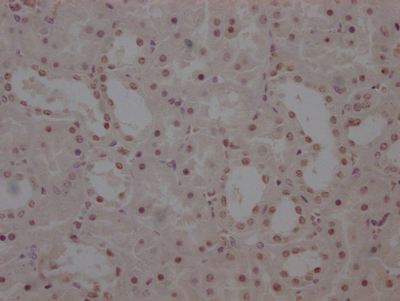
組織特異性:Predominantly expressed in fetal and adult kidney. In the kidney, it is found in the cortical and medullary collecting ducts. Also present in the adult pancreas, but at much lower levels. Detectable in fetal and adult liver. Rather indistinct signal in fe
-
數據庫鏈接:
Most popular with customers
-
-
YWHAB Recombinant Monoclonal Antibody
Applications: ELISA, WB, IHC, IF, FC
Species Reactivity: Human, Mouse, Rat
-
Phospho-YAP1 (S127) Recombinant Monoclonal Antibody
Applications: ELISA, WB, IHC
Species Reactivity: Human
-
-
-
-
-