AKR1C1 Antibody
-
中文名稱:AKR1C1兔多克隆抗體
-
貨號:CSB-PA188838
-
規(guī)格:¥1100
-
圖片:
-
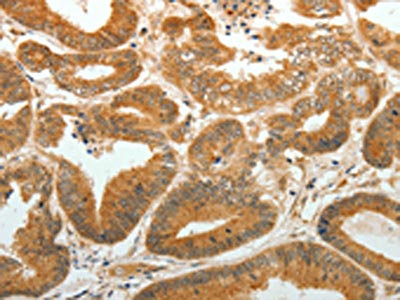 The image on the left is immunohistochemistry of paraffin-embedded Human colon cancer tissue using CSB-PA188838(AKR1C1 Antibody) at dilution 1/30, on the right is treated with synthetic peptide. (Original magnification: ×200)
 -
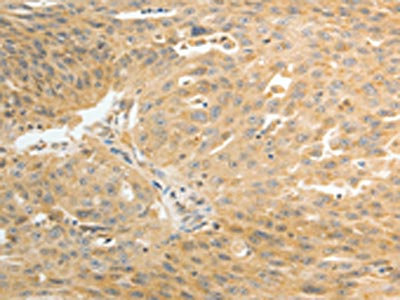 The image on the left is immunohistochemistry of paraffin-embedded Human ovarian cancer tissue using CSB-PA188838(AKR1C1 Antibody) at dilution 1/30, on the right is treated with synthetic peptide. (Original magnification: ×200)
 -
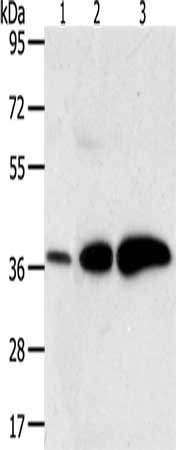 Gel: 10%SDS-PAGE, Lysate: 27 μg, Lane 1-3: Human liver cancer tissue, Human breast infiltrative duct tissue, human fetal brain tissue, Primary antibody: CSB-PA188838(AKR1C1 Antibody) at dilution 1/500, Secondary antibody: Goat anti rabbit IgG at 1/8000 dilution, Exposure time: 2 minutes
-
-
其他:
產(chǎn)品詳情
-
Uniprot No.:
-
基因名:AKR1C1
-
別名:2-dihydrobenzene-1 antibody; 2-diol dehydrogenase antibody; 20 alpha (3 alpha) hydroxysteroid dehydrogenase antibody; 20 ALPHA HSD antibody; 20 alpha hydroxysteroid dehydrogenase antibody; 20-alpha-HSD antibody; 20-alpha-hydroxysteroid dehydrogenase antibody; 20ALPHAHSD antibody; 2ALPHAHSD antibody; AK1C1 antibody; AK1C1_HUMAN antibody; AKR1C1 antibody; Aldo keto reductase family 1 member C1 antibody; aldo-keto reductase C antibody; Aldo-keto reductase family 1 member C1 antibody; Aldo-keto reductase family; 1 member 1 antibody; C9 antibody; Chlordecone reductase homolog antibody; Chlordecone reductase homolog HAKRC antibody; DD1 antibody; DD1/DD2 antibody; DDH antibody; DDH1 antibody; Dihydrodiol dehydrogenase 1 antibody; Dihydrodiol dehydrogenase 1/2 antibody; dihydrodiol dehydrogenase 1; 20-alpha (3-alpha)-hydroxysteroid dehydrogenase antibody; dihydrodiol dehydrogenase isoform DD1 antibody; Dihydrodiol dehydrogenase; type 1 antibody; H37 antibody; HAKRC antibody; HBAB antibody; Hepatic dihydrodiol dehydrogenase antibody; High affinity hepatic bile acid-binding protein antibody; High-affinity hepatic bile acid-binding protein antibody; Indanol dehydrogenase antibody; MBAB antibody; MGC8954 antibody; Trans-1 antibody; Trans-1,2 dihydrobenzene 1,2 diol dehydrogenase antibody; Type II 3 alpha hydroxysteroid dehydrogenase antibody
-
宿主:Rabbit
-
反應種屬:Human
-
免疫原:Synthetic peptide of Human AKR1C1
-
免疫原種屬:Homo sapiens (Human)
-
標記方式:Non-conjugated
-
抗體亞型:IgG
-
純化方式:Antigen affinity purification
-
濃度:It differs from different batches. Please contact us to confirm it.
-
保存緩沖液:-20°C, pH7.4 PBS, 0.05% NaN3, 40% Glycerol
-
產(chǎn)品提供形式:Liquid
-
應用范圍:ELISA,WB,IHC
-
推薦稀釋比:
Application Recommended Dilution ELISA 1:2000-1:5000 WB 1:500-1:2000 IHC 1:50-1:200 -
Protocols:
-
儲存條件:Upon receipt, store at -20°C or -80°C. Avoid repeated freeze.
-
貨期:Basically, we can dispatch the products out in 1-3 working days after receiving your orders. Delivery time maybe differs from different purchasing way or location, please kindly consult your local distributors for specific delivery time.
-
用途:For Research Use Only. Not for use in diagnostic or therapeutic procedures.
產(chǎn)品評價

相關產(chǎn)品
靶點詳情
-
功能:Cytosolic aldo-keto reductase that catalyzes the NADH and NADPH-dependent reduction of ketosteroids to hydroxysteroids. Most probably acts as a reductase in vivo since the oxidase activity measured in vitro is inhibited by physiological concentrations of NADPH. Displays a broad positional specificity acting on positions 3, 17 and 20 of steroids and regulates the metabolism of hormones like estrogens and androgens. May also reduce conjugated steroids such as 5alpha-dihydrotestosterone sulfate. Displays affinity for bile acids.
-
基因功能參考文獻:
- AKR1C1 activates STAT3 pathway to promote NSCLC metastasis. PMID: 29344298
- Decreased invasion caused by AKR1C1 knockdown suggests a novel role of AKR1C1 in cancer invasion, which is probably due to the regulation of Rac1, Src, or Akt. An inflammatory cytokine, interleukin-1beta, was found to increase AKR1C1 in bladder cancer cell lines. PMID: 27698389
- Data show that increased levels of AKR1C1/C2 enhanced the sensitivity of esophageal squamous cell carcinoma (ESCC) cells to ethyl-3,4-dihydroxybenzoate (EDHB). PMID: 26934124
- the present study suggests that AKR1C1, AKR1C2, AKR1C3, and AKR1C4 are closely associated with drug resistance to both CDDP and 5FU, and that mefenamic acid, an inhibitor of AKR1C, restores sensitivity through inhibition of drug-resistance in human cancer cells. PMID: 28259989
- Activation of AKR1C1/ERbeta induces apoptosis by downregulation of c-FLIP in prostate cancer cells. PMID: 25816367
- results suggest a gender-specific modulatory effect of AKR1C1 on anxiety levels, most likely through changes in progesterone and allopregnanolone levels within and outside the brain PMID: 24390875
- Studies indicate that mutations in aldo-keto reductase family 1 (AKR1) enzymes AKR1C1 and AKR1C4 are responsible for sexual development dysgenesis and mutations in AKR1D1 are causative in bile-acid deficiency. PMID: 24189185
- activation of the Nrf2/AKR1C axis may contribute to oxaliplatin resistance in gastric carcinoma PMID: 23933386
- The involvement of up-regulated AKR1C1, AKR1C3 and proteasome in CDDP resistance of colon cancers. PMID: 23165153
- Which promoted significant reduction of AKR1C1 and AKR1C2 expression. PMID: 23183084
- Data suggest that interleukin-1beta facilitates progesterone metabolism in cervical fibroblasts by regulating expression of AKR1C1 and AKR1C2. PMID: 22064385
- It was concluded that the truncated E6 protein of human papillomavirus 16, known as E6*I, has a novel function in upregulating expression of human AKR1C. PMID: 22278827
- role of AKR1C1in the metabolism of testosterone and progesterone via the 5beta-reductase pathway. PMID: 21521174
- enhanced metabolism of progesterone by SRD5A1 and the 20alpha-HSD and 3alpha/beta-HSD activities of AKR1C1, AKR1C2 and AKR1C3 PMID: 21232532
- analysis of single nucleotide polymorphisms of AKR1C1 and AKR1C2 PMID: 21217827
- Functionally expressed human AKR1C1 (20alpha-hydroxysteroid dehydrogenase) in the fission yeast Schizosaccharomyces pombe and demonstrate the ability of the resulting yeast strain to efficiently catalyze the reduction of progesterone or dydrogesterone. PMID: 20727920
- non-stereo-selective cytosolic human brain tissue 3-ketosteroid reductase is refractory to inhibition by AKR1C inhibitors PMID: 20673851
- Expression of dihydrodiol dehydrogenase in the resected stage I non-small cell lung cancer PMID: 11956619
- Reduction of dihydrodiol dehydrogenase expression is associated with resected hepatocellular carcinoma PMID: 12579257
- progesterone itself contributes to the regulation of local progesterone concentration through 20alpha-HSD levels in endometrial stromal cells at peri-implantation periods. PMID: 12733716
- X ray diffraction and site-directed mutagenesis: identification of an alternative binding site for C21-steroids PMID: 12899831
- Glaucomatous optic nerve head astrocytes express a higher level of 3 alpha-HSD isoform AKR1C1 and its mRNA than normal astrocytes. PMID: 13678667
- Expression of SRD5A1 (5alphaR1) and SRD5A2 (5alphaR2) is elevated, and expression of AKR1C1 (20alpha-HSO), AKR1C2 (3alpha-HSO3) and AKR1C3 (3alpha-HSO2) is reduced in tumorous as compared to normal breast tissue. PMID: 15212687
- Loss of AKR1C1 and AKR1C2 in breast cancer results in decreased progesterone catabolism, which, in combination with increased PR expression, may augment progesterone signaling by its nuclear receptors. PMID: 15492289
- mRNA abundance and activity of AKR1C enzymes in abdominal adipose tissue are positive correlates of adiposity in women. Increased progesterone and/or dihydrotestosterone reduction in abdominal adipose tissue may impact fat cell metabolism. PMID: 15494612
- The expression of AKR1C1 and AKR1C3 in endometrial cancer will govern the ratio of P:E2. PMID: 16338060
- DDH may play important roles in tumor progression of squamous cell carcinoma via induction of apoptosis- and drug-resistance PMID: 16361083
- Activity of AKR1C1 in overall oracin reduction was one order of magnitude higher compared to AKR1C2 and 1C4. PMID: 17618725
- Carbonyl reductase-1 (CBR1), microsomal prostaglandin E synthase-1 and 2 (mPGES-1, mPGES-2), cytosolic prostaglandin E synthase (cPGES), aldoketoreductase (AKR1C1) and prostaglandin F synthase (AKR1C3) were all expressed in hair follicles. PMID: 17697149
- Carbonyl reductase-1 (CBR1), microsomal prostaglandin E synthase-1 and 2 (mPGES-1, mPGES-2), cytosolic prostaglandin E synthase (cPGES), the aldoketoreductase AKR1C1 and the prostaglandin F synthase AKR1C3 were all expressed in hair follicles. PMID: 17697149
- Overexpression of AKR1C1 counteracted the S-phase accumulation of cells and apoptosis caused by MTX treatment. This suggests a role of AKR1C1 in cell proliferation. PMID: 17945194
- Incubations of normal human bronchial epithelial cells with individual heavy metals showed that the upregulation of AKR1C1 and AKR1C2 was predominantly caused by lead. PMID: 18654764
- Induction of preadipocyte differentiation increased expression levels of AKR1C1 and modified the pattern of progesterone metabolism substantially, leaving 20alpha-hydroxyprogesterone as the main metabolite generated. PMID: 18984031
- human AKR1C enzymes (AKR1C1-4) are able to reduce conjugated steroids such as Dht-17beta-glucuronide (DhtG), Dht-17beta-sulfate (DhtS), and Tib-17beta-sulfate (TibS) PMID: 19218247
- AKR1C subfamily genes are stress-inducible and might function as survival factors in keratinocytes. PMID: 19320734
- AKR1C isoforms as a novel target of jasmonates in cancer cells. PMID: 19487289
- Human AKR1C enzymatic activity plays crucial roles on induction of neoplastic transformation of mouse NIH3T3 cells. PMID: 19696165
顯示更多
收起更多
-
亞細胞定位:Cytoplasm, cytosol.
-
蛋白家族:Aldo/keto reductase family
-
組織特異性:Expressed in all tissues tested including liver, prostate, testis, adrenal gland, brain, uterus, mammary gland and keratinocytes. Highest levels found in liver, mammary gland and brain.
-
數(shù)據(jù)庫鏈接:
Most popular with customers
-
-
YWHAB Recombinant Monoclonal Antibody
Applications: ELISA, WB, IHC, IF, FC
Species Reactivity: Human, Mouse, Rat
-
Phospho-YAP1 (S127) Recombinant Monoclonal Antibody
Applications: ELISA, WB, IHC
Species Reactivity: Human
-
-
-
-
-